Every time I play Forge of Empires I discover new features. For example, I did not know that a storyline exists. I learned that players advance their storyline by completing quests. The more players advance their storyline, the more prizes they receive. Due to the fact that Halloween just past, Forge of Empires provided users with a “special event.” This special event is a limited time offer and allows players to complete quests in order to receive prizes (such as coins, metals, and other random rewards) as well as limited time buildings (such as a “haunted tower”). Moreover, I believe that there are a variety of “daily tasks” that players can conduct and engage in. Some of these tasks include collecting the coins that appear on top of buildings on your land, advancing your research by using your forge points, keeping your towns people satisfied and happy by giving them work to do as well as building monuments/plants. Another new feature I learned today is about the gold stars that appear on my established buildings. To my understanding, I receive these stars when other players of the game “aid”(i.e. polish) my buildings. Additionally, this gives my townspeople temporary happiness, which is an important aspect of this game. Thus, I have begun to aid other players as well. 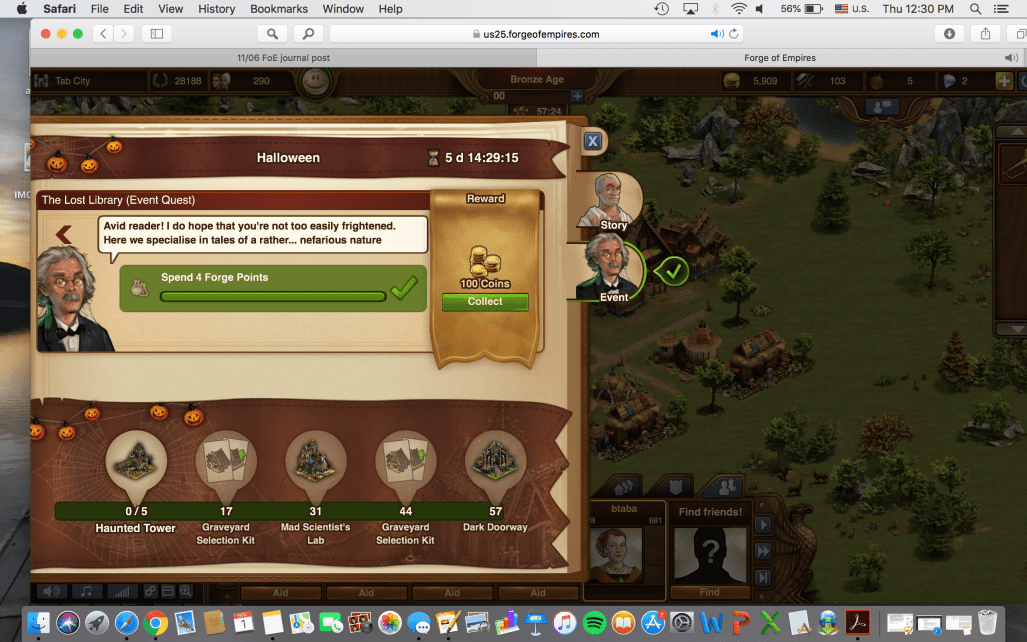
Category: Uncategorized
11/8 blog reflection
The Shakespeare video-game that Bloom is working on, alongside various colleagues from UC Davis, engages players in a cognitive and physically way — by immersing them in the performances’ actions. In theater-making games, players can inhabit the roles of stage designer, wardrobe manager, dramatist, etc., and therefore learn about “theatrical enskillment.” By teaching gamers about the process of theater production, players’ critical engagement skills will be enhanced when they attend an actual Shakespeare performance. Bloom argues that theater-themed games are pedagogically effective when the materials portrayed in the game resemble the materials used in actual theater production. The author also thinks that it is important to have the players physically engage with the game; this means that if a player moves his/her own body, that should control their on-screen character body movements as well. Davis’s ModLab is developing a game known as “Play the Knave”, which allows players to stage a scene from Shakespeare. In this game, the players gestures and voice maps onto/animates their on-screen avatars. The scene that the players created is recorded, and they are therefore able to post it on public sharing sites or with other users. Unlike other games out there, “Play the Knave” allows players to embody all the roles in the theater-making process. Thus, “Play the Knave” is a good example of how theatrical performance and technological games can be infused. In Bloom’s forthcoming article, she describes in detail how to navigate through the game. She mentions that players have the ability to select one from among hundreds of scenes from Shakespeare dramas. She also explains that the game targets a wide range of student audiences — including elementary schoolers, high schoolers, and beyond. For example, the “Play the Knave” platform was used in an elementary school classroom to teach student about how punctuation marks are used to highlight certain key words. Finally, Bloom provides tips for educators that teaches them how to incorporate “Play the Knave” in their curriculum. For instance, she states that teachers should only use the game to support their lesson plan; in other words, the game should not be used as a full lesson plan.
I really enjoyed reading these two articles and I was able to make personal connections to the readings. In my high-school English classes, I was asked to act out a Shakespeare scene with a few of my peers. The teacher assigned every group the same scene to act out because he wanted us to learn the variations in which one scene can be interpreted. Although I am not such a big fan of reading Shakespeare, I actually had a lot of fun conducting this activity because I love theater. After reading Bloom’s articles, I wonder how different my experience would have been if my group members and I played a game similar to “Play the Knave.” Because the players’ body movements animate the on-screen avatar, players still get a feel for what it feels like to perform live, which I think is great. I definitely think this is a unique and creative game — one that English educators should implement into their curriculums.
Questions:
- Do you think that games can be used to understand performance?
- What if the student is an avid gamer, but not a fan of theater or Shakespeare? Do you think he/she would still be interested in playing?
11/6 blog reflection
Vikaros and Degand argue that fantasy play — including video games and virtual worlds — can facilitate moral development because it emulates social interactions. They start off their chapter by highlighting the differences between morals and ethics. According to the authors, a moral is a widely considered principle of what is right and wrong, while an ethnic is a set of morals that is constructed by one’s culture. As children, we develop our moral compass through play. As we age however, morality aligns with our socio-culture. The authors then explain that humans develop schemas, which are mental structures that inform our understanding of what something is. Schemas are used to inform decision making, guide human thought, and to accommodate to new experiences and information. There is no set age that morality develops because it is highly dependent on experience. Thus, games that involve social narratives, promote children’s moral development. Even without the actual presence of social interaction, play can be a social narrative. By virtually interacting with real people and/or interacting with digital characters, technology advances to make their products more and more socially immersive. The play that incorporates perspective taking, decision making about moral dilemmas, and interpersonal negotiation is what leads to moral development. Vikaros and Degand then provide examples of games that enable social narrative play. One example is September 12, which is a game that we discussed and interacted with during lecture. This game addresses a complex, moral issue in a straightforward manner, and users are able to witness the consequences of their actions (such as launching a missile). Although fantasy play disappears in adolescence, adults continue to engage in cognitive interplay of social narratives like during debates or dramatic performances. I also really enjoyed the “Decisions that Matter” interactive experience. Having the autonomy and ability to make decisions by clicking on responses made me feel like I am in control of the “game.” In addition, it was interesting to watch the consequences of my actions and responses unfold. I also like how the interactive experience allows users to go at their own pace. Everyone reads at a different rate and processes information differently, so giving the users the ability to click “next” is an important feature. Finally, I like how the game was personalized; instead of referring to me as a “player”, I was called by my first name.
I really enjoyed reading this article. I believe that achieving a high stage of morality is important, yet not easy to accomplish. I believe that society must begin to view games (and technology as a whole) in an educational manner, rather than simply a fun and entertaining tool. When I read the authors discussions, I thought about the Arthur Media Interactive project. I think that AIM is a good game in which children have the potential to develop morality. If AIM users are able to take the perspective of not just Arthur, but his friends as well, this will continue to their moral development. In addition, it would be useful if the players are able to make meaningful choices as a specific character and witness its consequences. For example, think about the scenario in which Arthur pokes fun at Buster’s sweater. Players should be able to pretend they are Arthur and make decisions about what they want to say to Buster, about Buster’s sweater. As a result of their decisions and comments to Buster, players should be able to watch Buster’s emotional reaction unfold. In other words, players will make meaningful choices that lead to meaningful consequences.
Question:
1) What is defined as an “effective” moral decision? What if players’ values differ than the morals facilitated by the game experience? How can the creators/inventors of digital media games address this?
10/30 FoE blog post
Today I played Forge of Empires and discovered new features! For example, I learned that there is a “global chat.” I think this means that players from different parts of the world are able to communicate with one another. I also learned that there is more to the game than simply developing and managing your own city. Using the continent map, users can enlarge their empires, and receive valuable rewards by doing so. The various sections of the continent map seem to map on to the game’s age periods. A user can get to the continent map by clicking on the compass logo placed on the bottom-left side of the screen. In order to conquer more of the continent/land, a user needs to fight battles. In addition, users enter a new era by unlocking a technology from that time period. This is done through the research tree which is placed at the bottom right of the screen and its logo is a chemistry symbol. Moreover, users can advance through this research tree by using forge points, and forge points are granted automatically, with time. I am currently in the Bronze Age, and the tools that I am able to use are stones and wood.
Furthermore, I am beginning to discover that one of my favorite parts of this game is learning and discovering the various ways to make my city people happy. It seems that they get angry quickly; thus, learning how to make them happy again has been an enjoyable challenge for me. Additionally, I recently noticed a gold star that appeared above one of my buildings. I ask my classmate about this and he mentioned that it denotes the high worth of my building. What I am still trying to discover is how I received that gold star/what I did to receive that gold star. My initials thoughts are that by gaining more friends, my production level increases, and therefore I am granted gold stars.
10/30 blog post
In the NPR talk show, TED speakers reveal how easily manipulated individuals are. Manipulation, according to the talk, is to get someone to think a certain way and to act a certain way. There are four sections to this 50 minute podcast. The speakers first begin by talking about how technology is used to persuade people and how humans’ minds have been shaped by technology. With time, technology is becoming more intelligent and personalized. They also compare social media (like snapchat) to a cult — one that is effecting peoples’ ability to have good conversations and connections with people. The podcast then talks about fake news and how false information can be used to manipulate people. This portion of the podcast is completed by Ali Velshi who is a journalist. Furthermore, Professor Loftus researchers false memories and explains how peoples’ memories can be controlled and manipulated. According to Loftus, our memories tell us who we are as well as who we want to be. She talks about a man named Titus who was accused of raping someone, yet in actuality, he was innocent. She argues that contrary to popular belief, memory is not a recording device; in fact, memories work like a Wikipedia page in which you could change it/alter it and so can other people. Finally, Professor Ramirez talks about the pros and cons of erasing memories. He describes that he performed a research study on mice in which he implanted a new memory in place of an old one
I really enjoyed listening to this podcast; I think it may have been my favorite homework assignment thus far! I was able to make many personal connections to various points made in the talk. In the beginning of the podcast, Tristan Harris talks about the detrimental effects of constantly using our cellphones use and he specifically talks about snapchat streaks. I had a snapchat streak with one of my friends back home and every morning I would send her a snapchat to keep our streak “alive.” The type of snapchat pictures I would send her were truly meaningless and pointless; it did not reveal anything about my day, how I am doing or feeling, etc,. The picture was either a selfie or even a photo of the wall or floor. I wrongfully convinced myself that because of our ongoing snapchat streak, her and I were “always talking.” When I went on vacation and did not bring my phone along with me, I was so worried about loosing my streak with this friend. After listening to this NPR podcast and looking back at this memory, I am amazed by how addicted I was to keeping my snapchat streak alive.
Questions:
- Is checking your cellphone (I.e. your missed calls, text messages, scrolling through social media, etc,.) the first thing you do in the morning?
- Have you ever been convinced that an event occurred, but people around you tell you that you are going crazy and that you are remember that event incorrectly?
10/25 blog post reflection
In Sherry Turkle’s TED talk she talks about peoples’ “plugged in” lives; by “plugged in” she defers to technology. She argues that technologies (such as phones) are psychologically powerful, and they are re-editing human connection. People are constantly using their phones — whether it is during a meeting, in class, or during a presentation. Additionally, when friends spend time together they are on their phones most of the time — denying each other their full attention. Moreover, in face of hardship and grief, people turn to their phones for comfort. This may be because when you are texting you have the ability to edit and delete what you say. However, Turkle states that texting does not allow people to learn from each other or understand one another. Nowadays, robots, such as Siri, are designed to be companions; yet, how can one make sense fo their life with a machine that has no real life experiences? Due to peoples’ heavy reliance on technology, humans do not have the capacity for solitude. Individuals wrongfully believe that always being connected is going to them feel less alone. Furthermore, Danah Boyd talks about the complicated ways that teens try to achieve privacy. She states that teens care deeply about privacy and do innovative things to achieve privacy. She also makes a distinction between being in public and being public. Yet, online it is difficult to be in public without being public. Boyd then discusses how teens have been achieving privacy. She gives one example of a girl who hops from one foster home to another and constantly deactivates and reactivates her facebook so that her new foster parents do not see what she is up to. Thus, this teenager asserted control in the social situation she found herself in.
Boyd’s lecture about being in public verses being public really stood out to me. I never really took a moment to think about the difference until I watched her video. I think it is important to realize this distinction. In addition, as she was explaining examples of how teens “achieve privacy” I thought of a personal experience. In my senior year of high school many students changed their names on facebook so that colleges’ admission counselors are not able to look them up. For example, my friend Joseph changed his name to “Trader Joes.” As soon as he got into college however, he changed his name back.
Questions:
1) Should “robots” (such as Siri) continue being invented? Or are these products decreasing in person, human interaction?
2) What can we do to make sure that teens avoid using their phones when they are together?
3) What is your example of “achieving privacy” as Danah Boyd defines/describes it?
10/23/18 blog responses
My response to Derek’s blog post from 10/11/18:
I think it is so great that you have the opportunity to intern at a kindergarten this quarter. It must be nice comparing and contrasting your elementary school education to theirs. Furthermore, I think that it is great that this classroom has a school psychologist come in and teach children about character development. I feel like nowadays schools and educational institutions are so caught up on teaching students academic subjects (such as math, english, and science) and preparing them for state tests; what they fail to realize is that these same students need to build social skills as well — in order to be functional, contributing members of the society.
My response to Maricar’s blog post from 10/11/18:
Nice reflections! I also loved learning about AIM, and I believe that its objectives and goals are great. It allows children to disentangle from a typical classroom setting and focus on character development in a fun and interactive way. I also did not have interactive stories that helped me develop socially, but I wish I did!
10/25 FoE blog post
Today I played Forge of Empires with a classmate who is familiar with the world of online gaming, so he helped me understand aspects of this game that I was still unfamiliar with. For example, I learned how to check how many people are in my town. I also learned that adding plants (I.e. trees and flowers) on my land, will positively effect and alter the mood of my townsmen. In addition, I learned that forge points are provided automatically and can be used to advance the era you are in; thus, I used my forge points to advance into the Bronze Age. I am also beginning to understand the game currency. I understand that diamonds can be bought with real money, but can also be acquired through completing some quests. Furthermore, I realized that you can gain medals by winning tournaments. Learning about the ways to receive coins took me a while to understand, but I think I now know how it works. The more you establish buildings, the more workers you get, and therefore the more coins you receive. In other words, it seems as though as townsmen come in and out of the buildings I have built, I am gaining coins. Additionally, as I mentioned in my previous blog, I do believe that there are educational opportunities in this game. With that being said, I have some ideas about an educational redesign possibility; perhaps as users advance through eras they can be given more information about those eras. For example, I realized that when I advanced to the Bronze Age, the buildings looked more developed. However, I would have liked to be given more historical facts and information about the era — including the era’s dates, information about the tools used during that time, what caused its rise and collapse, etc,.
10/23 FoE blog post
Today was my third time logging into my Forge of Empires gaming account. I definitely believe that there are educational possibilities and an element of didactic effectiveness in the game. From the Stone Age on through the centuries, users can explore the new technologies and tools that are prominent in that era. As players establish and build their settlements, they can also explore new building types. I also believe that the game requires its players to develop economic skills; this skill is needed in order to finance the growth of the users’ empires. Furthermore, I downloaded Forge of Empires on my iPhone and to be honest, I did not like it very much. I would rather play the game on my laptop. This may be a personal preference because (in general) I do not like playing games or using social media on small screens. For example, I would prefer to go on Facebook using my laptop than using my iPhone. Consequently, due to the phone’s small screen, everything in the game, including the land and buildings, looked compact and it was difficult to navigate my way around.
10/18 FoE blog post
This was my second time logging into my account and playing the game “Forge of Empires”. Outside of this class, I am not much of a gamer. Additionally, while growing up, I was never interested in playing video games or interacting with online games. Thus, playing FoE is truly a novel experience for me. It took me a while to find where the avatars are in the game. The avatar that has been automatically selected for me is a woman, in the Bronze Age, who looks like she is wearing a unique head-piece and gold necklace. When I click on my current character, I am given the choice to select another avatar. The various avatars portrayed have distinct stereotypic female and male characteristics. Nevertheless, the clothing of each avatar varies. For example, there are some avatar’s wearing “modern day clothing” — a polo shirt or a zip-up sweater. Moreover, based off of the avatars’ facial features, it is apparent that some are older (in age) than others. There are four pages of avatars that a gamer could choose from, which I think is great because it allows the user to pick the avatar he/she identifies with most. The game menu is not too difficult to navigate. I think this is because the menu is clearly portrayed on the bottom left side of the screen and each time you hover over one of the buttons there is a text that pops up and tells you what the button represents. To be honest, I am still not too sure of the game’s objective. I realize that coins sporadically appear on top of the buildings I have created, but I do not understand how I am gaining these coins/under what circumstances these coins appear.
 UWP 104D