Addressing The Needs of Preschoolers With Autism Spectrum Disorder

Addressing The Needs Of Autistic Preschoolers In The Classroom

As soon-to-be teachers, we could all agree that education access is a basic human right; every child deserves to receive an adequate and quality education — including children with disorders or special needs. In this blog, I will focus on Autism Spectrum Disorder (ASD); I will describe the ways in which educators can accommodate their teaching style and curriculum to address the developmental and academic needs of autistic children. This blog is especially useful for educators who hope to work with children on the spectrum, as well as educators who advocate for an inclusive education paradigm.

An inclusive education implies integrating children with disabilities or disorders (like autism) into a mainstream, school setting. It is challenging, yet immensely rewarding to create a well-structured inclusive education program. Under these circumstances, an educator will be required to address the needs of students who do and do not conform to typical developmental trajectories. Also, you may want to keep this in mind…the issue of inclusion is passionately debated. Although there are several benefits to mainstreaming students with disabilities (e.g. exposing children to diversity and offering opportunities for social development), many parents have reservations about inclusive educational practices. Parents with typically-developing children are concerned that this can slowdown the pace of the classroom and have a negative effect on their child’s academic growth. Simultaneously, parents with children on the autism spectrum worry that their child will feel like the ‘odd one out’ and/or uncontrollably anxious in a mainstream learning environment.

Years of research has helped us define autism; researchers have identified the everyday difficulties affected individuals face, as well as how to address these difficulties. Autism is typically diagnosed around age 2 or 3, and it is estimated to affect 1 in every 58 children. For this reason, promoting the wellbeing of autistic children and optimizing their skill acquisition inside of a preschool classroom is more important than ever. 

So, what exactly do autistic children struggle with? Autism Spectrum Disorder consists of a broad range of conditions characterized by challenges with social skills (e.g. difficulty maintaining eye contact), a lack of attentiveness, and trouble managing sensory input. It is important to note that autism has many subtypes, and each individual with autism possesses unique strengths and weaknesses. Because this disorder is a spectrum condition, it effects individuals to varying degrees.

Many of you may be thinking: “Of course I want to support the developmental potential of autistic students in my classroom. But, how? How can I, as a future educator, better address the everyday difficulties that autistic children face?” I will answer these questions by referring to relevant evidence-based findings…so read on!

Adapting The Classroom Setting To Benefit Children With Autism: 

Researchers Brodzeller et al. (2018) concluded that there are certain strategies early childhood educators may implement, within inclusive settings, to help autistic children succeed in a classroom environment. These researchers worked one-on-one with Allen, a kindergartener who lies on the autism spectrum. Allen mainly struggles with cooperating during learner-centered activities and he has a hard time effectively communicating with his teachers and peers. To address his difficulties, Allen’s educators created a curriculum that was conducive to his needs. The results of this case study indicate that “material adaptations” can lessen autistic children’s anxiety and minimize sensory stimuli that typically over-stimulate them. One example of a material adaptation, which worked well for Allen, is the use of noise-dulling headphones; this accessory blocks out excess noise in the environment which allowed Allen to better focus on the task at hand. In addition, many autistic children, including Allen, are visual learners. Thus, using visual aids (such as videos that illustrate prosocial behavior) helped Allen acquire appropriate social skills because he modeled what he viewed. 

What can you take away from this study? Don’t be afraid to try it out! If you recall, I mentioned that autism is a spectrum. This means that every individual with autism exhibits unique characteristics and behaviors. Thus, the autistic student you work with is not guaranteed to undergo the same experiences or challenges as Allen. The chart below provides additional examples of material adaptations. Take a look at these examples and find one that resonants with you or simply sounds interesting. Once you begin working with an autistic student, incorporate this material adaptation in your classroom and conclude whether or not it benefitted this particular student. 
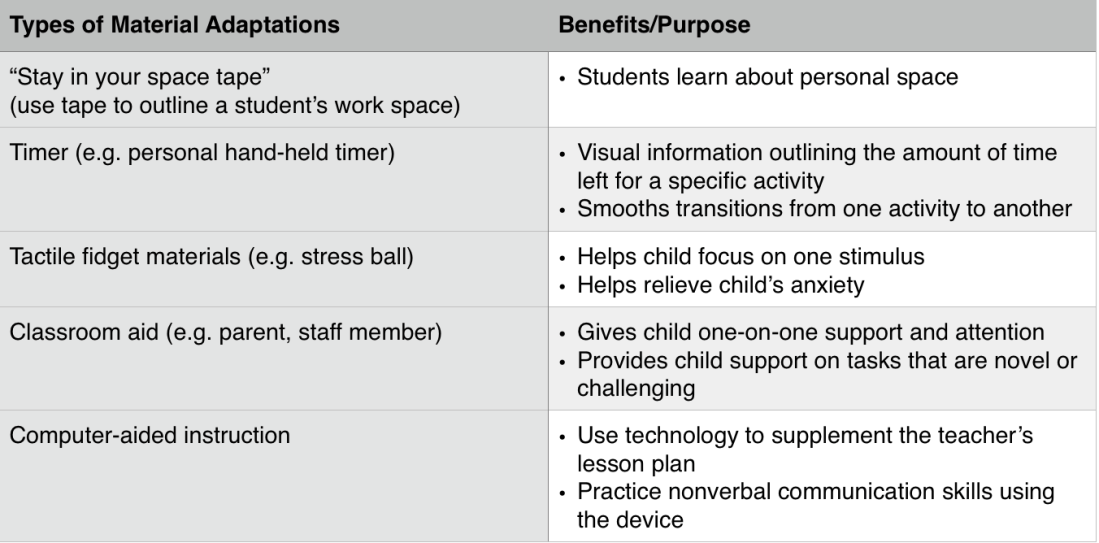
Screen Shot 2019-03-06 at 9.47.37 AM.png

The Benefits Of Using Reinforcements With Autistic Preschoolers: 

We are all familiar with the behavioral psychology concept of “reinforcement/s”; we know that rewards are used to strengthen a desired behavior. An example includes giving an autistic student a sticker, after watching him/her appropriately interact with his/her peer during playtime. The purpose of the sticker is to increase the likelihood that the autistic student will repeat this desirable and prosocial behavior in the future. The concept is pretty simple, right?

Good news! Two studies conducted in 2011 and 2012 concluded that using reinforcements with children who lie on the autistic spectrum can greatly improve their attention skills. The ability to sustain attention is undoubtedly critical for learning and therefore an important skill to develop. In fact, learning can only occur when the learner attends to the environment and absorbs the presented information. Researchers Watson and Pattern (2011) claim that there are various types of attention, including sustained attention (the ability to maintain attention for a long period of time) or joint attention (the ability to coordinate attention around a single object with a social partner). One effective way of improving autistic children’s attention skills is by providing reinforcements in the classroom. With increased attention abilities, students will unlikely disengage in the classroom material or dwell on irrelevant aspects of the lesson plan. 

Following The Student’s Lead & Teaching Based Off Of The Student’s Interests:

Remember that joint attention is the ability to coordinate attention around a single object with a social partner. According to researchers Kaale, Smith, and Sponheim (2012), children with autism show deficits in joint attention. Consequently, their social development is negatively impacted. In addition to providing reinforcements, another way to improve autistic children’s joint attention skills is by implementing naturalistic interventions in the classroom (Pindiprolu, 2012). This type of intervention is characterized by a child initiating a desire to learn and an adult reinforcing that child’s behaviors. For this reason, naturalistic interventions foster learner spontaneity. The child may indicate a “desire to learn” by looking, reaching, gesturing, naming, or requesting an item. You, as the teacher, should join in the autistic child’s toy interests, follow the child’s lead, and verbalize exactly what the child is doing. Following these strategies/tips will increase children’s abilities to gaze, point, attend to an object, et cetera. Moreover, adopting this strategy will not only promote teacher-child play, but it has also been shown to positively impact mother-child play at home (Kaale, Smith, & Sponheim, 2012). As a result, engaging in naturalistic interventions inside the classroom will improve autistic children’s joint attention skills and, in turn, cultivate social interaction. 

Focusing On Developing Autistic Children’s Communication Skills & Social Skills:

Back in 2016, researcher Grossi-Kliss conducted a survey with preschool teachers who reported that improving autistic children’s communication skills and social skills is vital. Building communicative skills will help children with ASD effectively interact with their instructor/s and classroom peers. Additionally, developing social skills (e.g. engaging in pretend play) will protect against a child’s social isolation. In the eyes of the teachers who participated in this survey, motor skills were the least important to strengthen in the preschool classroom. Unlike an occupational therapist, refining a fine or gross motor skill is not an educator’s main concern. This means that teachers are not responsible for having to ingrain each and every skill in their students. The conclusions of this study should also help you, as a future educator, create a curriculum that is centered around addressing the communication and social skills of your students. Grossi-Kliss’s findings nicely align with the results of the studies I described above because they address autistic children’s communication and social skills as well.

Main Takeaways & Classroom Applications: 

With all of these research-based methods and research studies in mind, I will highlight the main takeaways!

Teachers should…

  • Get to know the unique strengths and weaknesses of each autistic student because autism is a spectrum disorder; no two individuals are exactly alike.
  • Adapt and alter their curriculum to align with students’ interests and needs.
  • Create a curriculum that addresses students’ social skills and communication skills.
  • Use material adaptations (e.g. noise-canceling headphones) to reduce distracting, excess environmental stimuli and to help students focus on the task at-hand.
  • Use reinforcements as part of a behavior intervention plan; reinforcements increase the repetition of a desirable action and/or behavior.
  • Use reinforcements to increase children’s attention abilities/skills.
  • Allow the student to ‘take the lead’ and play an active role in their learning experience.

As you get ready to become an educator keep these findings in mind. I will leave you on this note: It is imperative to create a classroom environment that is receptive to the needs of children with ASD because it will provide a pathway for their future success. At the end of the day, what more can a preschool teacher ask for? 


References

Brodzeller, Katharine L., Ottley, Jennifer R., Jung, J., Coogle, Christan G. (2018). Interventions and Adaptations for Children with Autism Spectrum Disorder in Inclusive Early Childhood Settings. Early Childhood Education Journal, 46(3), 277-286.

Grossi-Kliss, J. (2006). Teaching children with autistic spectrum disorder: A preschool teacher survey to determine best practice approach. Journal of the American Academy of Special Education Professionals, , 1-10. Retrieved from https:// search.proquest.com/docview/1913353987?accountid=14505

Kaale, A., Smith, L., & Sponheim, E. (2012). A Randomized Controlled Trial of Preschool- Based Joint Attention Intervention for Children with Autism. Journal of Child Psychology and Psychiatry and Allied Disciplines, 53(1), 97.

Patten, E., & Watson, L. R. (2011). Interventions targeting attention in young children with autism. American Journal of Speech-Language Pathology, 20(1), 60-69. doi:http:// dx.doi.org/10.1044/1058-0360(2010/09-0081)

Pindiprolu, S. S. (2012). A review of naturalistic interventions with young children with autism. Journal of the International Association of Special Education, 13(1), 69-78. Retrieved from https://search.proquest.com/docview/1312419718? accountid=14505

Draft #1

As soon-to-be teachers, I think we could all agree that education access is a basic human right; all children deserve to receive an adequate and quality education — even children with disabilities or special needs. In this blog, I will focus on Autism Spectrum Disorder (ASD); I will describe the ways in which educators can accommodate their teaching styles and curriculums to address the developmental and academic needs of children who lie on the spectrum. This blog is especially useful for educators interested in working with autistic children, as well as educators who advocate for an inclusion education — integrating children with autism into a mainstream, school setting. 

Years of research has helped us define autism, including the deficits associated with living with the disorder and what can be done to address affected individuals’ daily struggles. Autism Spectrum Disorder consists of a broad range of conditions characterized by challenges with social skills (e.g. difficulty maintaining eye contact or delayed learning of language), executing appropriate behaviors, and sensory abilities. It is important to note that autism has many subtypes, and each individual with autism carries his or her own unique strengths and weaknesses. Because this disorder is a spectrum condition, it effects individuals to varying degrees. Autism is usually diagnosed around age 2, it is most commonly detected in males, and it is estimated to affect 1 in 59 children. Consequently, autism is a prominent disorder and a worldwide epidemic. For this reason, promoting the wellbeing of autistic children and optimizing their skill acquisition, inside of a preschool classroom, is more important than ever. 

Now, many of you may be thinking: “Of course I want to support the autistic population’s right to an education because it is important to make them feel like valued and functional members of our society. But, how can this be done? How can we, as future educators, better address the needs of autistic children beginning at a young age, specifically in primary school?” These are questions that I will answer in this blog post using relevant evidence-based findings. 

Concrete Example – A Case Study: 

In a 2018 study, a group of researchers worked one-on-one with a kindergartener, Allen, who lies on the autism spectrum. Allen mainly struggles with cooperating during learner-centered activities and has a hard time communicating effectively with his teachers and peers. To address his issues, Allen’s educators created a curriculum that was conducive to his needs. The results of this case study indicated that “material adaptions” can help lessen autistic children’s anxiety and minimize sensory stimuli that typically over-stimulates them. One example of a material adaption, which worked well for Allen, is the use of noise-dulling headphones; this accessory blocks out excess noise in the environment, allowing Allen to better focus on the task at hand. In addition, many autistic children, including Allen, are visual learners. Thus, using visual aids (such as videos) helped Allen acquire appropriate social skills because he modeled what he viewed. 

Using Reinforcements: 

Two studies conducted in 2011 and 2012 concluded that using reinforcements with children with ASD can improve their attention skills, promote spontaneous use of language, and decrease their destructive behaviors. These are skills pertinent to a classroom environment. An example of this includes giving an autistic student a sticker after watching him/her appropriately interact with his/her peer during playtime; the purpose of the sticker is to increase the likelihood that the student will repeat this advantageous and desired behavior in the future.

However, there is more to the story; it is not that simple. Researchers have advocated for the use of naturalistic interventions. As the name suggests, naturalistic interventions occur in natural contexts (e.g. during play), and are characterized by a child initiating a desire to learn and an adult reinforcing that child’s behaviors. This type of intervention is based on behaviorism and applied behavioral analysis (ABA), and it fosters learner spontaneity. With this in mind, a reinforcement should be granted only once the child, him or herself, has initiated a behavior.

I would also like to briefly discuss the importance of attention. The ability to sustain attention is undoubtedly critical for learning. In fact, learning can only occur when the learner attends to the environment and therefore absorbs the presented information. Researchers Watson and Pattern claim that there are various types of attention, including sustained attention (the ability to maintain attention for a long period of time) or joint attention (the ability to coordinate attention around a single object with a social partner). One way of improving autistic children’s attention abilities is by providing reinforcements. This strategy is especially useful for teachers who will work in inclusion education programs; by having students with similar attention abilities, educators may worry less about their special needs students suddenly disengaging in the classroom material or dwelling on irrelevant aspects of the lesson plan. 

In addition to effecting a child’s academics, a lack good attention skills interferes with children’s social development. Remember when I mentioned the importance of “following the child’s lead” when it comes to learning? This statement holds true when trying to improve autistic children’s joint attention. You, as the teacher, should join in the autistic child’s toy interests, follow the child’s lead, and verbalize exactly what the child is doing; doing so increases children’s abilities to gaze, point, attend to an object, et cetera. Adopting this strategy will not only promote teacher-child play, but it has been shown to also (positively) impact mother-child play at home. Specifically, researchers Kaale, Smith, and Sponheim found that joint attention cultivates social interaction in autistic children. 

Teachers’ Perspectives:

Back in 2016, researcher Grossi-Kliss conducted a survey that gathered information from preschool teachers working with autistic students; these teachers were asked to rank a total of 10 skills in order of most to least important. The results of the survey indicated that improving autistic children’s communication skills and social skills is extremely vital. This is because children with ASD need language in order to effectively communicate with their peers and the people around them. Social skills, such as pretend play, are also really important to develop because a lack of play can aggravate a child’s social isolation. In the eyes of these teachers, however, motor skills were the least important skill to develop in the classroom; this is because, unlike an occupational therapist, refining fine and gross motor skills are not an educator’s main concern. The conclusions of this study should help you build a curriculum centered around addressing the communication and social skills of your potential students. Grossi-Kliss’s conclusions also nicely align with the results of the sources I described above.

As described above, it is imperative to create a classroom environment that is receptive to the needs of children with ASD because it will provide a pathway for their future success. At the end of the day, what more can a teacher ask for? 

11.27.18

Steinkuehler (2013), who a game scholar, talks about her research on online video games. She argues that games are a great tool for learning in the classroom. More than the game itself, its the idea that games capture students’ interests, and that is what promotes learning. Teenage boys are failing out of school and this is becoming a big problem. Through experience, Steinkuehler has realized that teachers must allow for a “follow your interest” type of model. She noticed that the same students who were falling behind in school, began to excel in their studies when they were given the freedom to choose what to read. Students’ comprehension performance increased greatly because they began to care about the work they were doing; they persisted through the challenges they faced because they cared about the topic they were studying. Additionally, Degand (2015) conducted a case-study with two Black male high school students, and gathered information on their social success, their aspirations, their social experiences, and their experiences with media. Social success skills include traits such inter- and interpersonal intelligence or emotional intelligence. Degand was interested to examine the different ways that the teenager boys’ media experience played a role in their ability to acquire social success skills. He argues that pro-social media content exists to combat racism and positively influence the development of students. Degand adopts hermeneutical phenomenology to conduct his study in order to understand the perspectives of his participants. Namir (subject #1) defined success in terms of monetary worth, but he believed that social success was not dependent on financial means. He believed that people who are successful have completed their objectives. Mathieu (subject #2) defined social success as people who enjoy their lives and stay out of trouble. Both the subjects’ definitions of social success was dependent on their family experiences. Because Mathieu’s immediate social circle consisted of individuals who attended college, he was able to include specific details from his family member’s experiences; yet, Namir was not able to do so. Both Namir and Mathieu were planning to go to college once they graduated high school. Furthermore, Namir enjoyed watching comedy films, but he mainly spends his time playing video games. Mathieu’s interest in playing soccer leads him to spend more of his time learning about soccer game rules and strategies. Thus, the media content the subjects viewed was influenced by their personal aspirations and goals. However, the amount of time they spent engaging in medias that relate to their current ambitions were not the same. (For example, Namir is interested in music production-related activity, but spends more time playing video game-related activities). Degand argues that it is imperative to consistently participate in an activity that coincides with your long term goal. One reason is because it can help strengthen youths’ identity formation. Another reason is because media activity can help youth become more resilient. For instance, Mathieu can learn how to combat racism if he ever experiences it in the future because he may gain knowledge about players who confront racism. 

I can relate to Steinkuehler’s talk on a personal level. Whenever I am assigned (by a teacher) to read a novel for class, I am immediately turned off by the idea; I usually just think of it as another chore or dull assignment. However, when I am given the freedom to choose what I would like to read, I become an active participant in my learning experience, and I am able to engage with the text in front of me. Last quarter, in my Abnormal Psychology course, my professor provided us the opportunity to read any book that interested us and to write a reflection. The only catch was that it had to be related to mental health. Thus, I have an extraordinary amount of choice in deciding what to read. I decided to read a book that discussed the detrimental effects of anxiety, and as a result I began to become more interested in this topic. I attended my professor’s office hours to learn about this disorder and asked her questions that extended beyond the scope of our classroom. 

Questions:
1) What are the benefits of using high school boys as participants (in Degand’s study)? 

2) Have you ever had to teach a group of students? Did you ever find it difficult to capture their attention/engage them in the material you were teaching? If so, how did you overcome this challenge?

3) Do you believe that media experiences/engaging in media has the potential to “strengthen identity formation in youth?” (Degand, 2015).  

11/20 FoE

Unlike many of my other classmates and peers, I recently joined a guild. This is because I recently unlocked the Smithery technology. I have joined the guild known as The Dawn Trader. I wonder what the differences are between each guild. I also do not understand what to do now what I am a part of a guild. As of now, I keep “aiding” the member of my guild. Moreover, I am very close to entering the Iron Age; I think by next week I should be in the Iron Age. I recently received a message letting me know that “Guild vs Guild” is available after I join a guild (which I have already done) and once I have unlocked the Iron Age. I do not understand what “Guild vs Guild” means so I hope to figure this out soon. Additionally, I recently discovered the “Market” tab that exists at the bottom left side of my screen. This allows me to trade goods with — what seems to be — other players of the game. Apparently, all that I can offer as of now are two marbles. I am not sure where these marbles are coming from and what they are worth. 

Although I believe I have advanced a lot since I first began playing this game (by building many monuments and buildings, collecting a lot of coins, constantly making my townsmen happy, and (almost) advancing to the Iron Age), I still find myself asking many questions and feeling confused while playing. A lot of the actions I complete are based off of me guessing what the right thing to do is. I also find myself asking my of my classroom peers — those who are regular online gamers — how to complete tasks. This was my first time really immersing myself in an online game and I am glad I was given the opportunity to do so. With that said, I find the game boring and repetitive a majority of the time. This may be because I feel stuck and unsure how to advance. At some point while playing, you run out of forge points and diamonds…so then what? What are you supposed to do next? If you do not want to spend real money, you have to wait a couple hours until you are awarded diamonds and forge points. Additionally, even though there may be pros to this, in my eyes, the game lacks an element of loosing and winning. Because of this, I am not excited to log on and play, and find myself asking “So what? What’s the point of advancing and building my empire?” I have also noticed that the game keeps advising me to buy (with real money) diamonds. This may be enticing for someone who is a gamer and enjoys playing online games, but this does not appeal to me, and I find myself quickly exiting out of it. 

11/20

Authors Schaefer et al. (2016) explore how youth use a tracking device to document and keep track of their personal health data. A 6-month study with youth was conducted in order to explore this issue. The youth were ages 11-12 and came from low-income, urban backgrounds which meant that there was low technology access. Each participant was given a wearable technology; the Fitbit was the physical activity monitoring system that was used. There was a quantitative and a qualitative analysis in the study. The quantitative component examined students’ engagement with the Fitbit. Engagement was defined as wearing and syncing the device on a server regularly, activity level was translated to the number of steps participants took, and behavior change meant the differences between baseline and activity levels. The qualitative component of the study was designed to gather data about the participants’ (the youths in the study) thoughts about using the fitness device. To collect this qualitative data, the researchers conducted focus groups. A variety of results were reported. There was indication of initial reactivity which meant that the participants altered their performance due to the awareness that they were being observed. Moreover, the participants’ engagement seemed to be boosted when a researcher was present. The amount that participants engaged with the device daily kept dropping. Additionally, there were gender-based different in how the participants used the device. In specific, males reported using the Fitbit to compete with each other, while females worked collectively to increase personal activity data. Many participants also reported a personal behavior change as a result of using the Fitbit. For example, some of the youth reported wanting to engage in physical activity more. The authors concluded that in order to get youth to engage in self-tracking, they need incentives and external motivators. The results suggests that the Fitbit alone does not cause signifiant changes in peoples’ existing physical activity practices. Furthermore, Jane McGonigal (2012), a game designer, begins her TED talk by telling her audience that she will increase their lifespan by 7.5 minutes. Her passion for playing gaming leads her to state that it is untrue to claim that gaming is a “taste of time.” She talks about the 5 top claims that people make on their death bed and argues that gaming can address these 5 statement. McGonigal claims that studies have proven that online games can outperform pharmaceuticals to treat clinical anxiety and depression, that it can be used as a tool to express oneself, etc,. The speak then provides a personal example; in order to heal from a very serious concussion she played games — that was her remedy. In fact, she created a game. The game that she had created (called “superbetter”) reached audiences with depression, cancer, Chron’s disease, and even ALS. The game intervened so powerfully in the lives of the users; it made them feel stronger and happier. This is known as post-traumatic growth, in which people find a new meaning and purpose in life; interestingly, this is the exact opposite of the top 5 regrets of the dying. McGonigal mentions that there are ways to achieve this post-traumatic growth without going through a traumatic event. Physical resilience can be boosted by actively moving, mental resilience (or willpower) can be strengthened by tackling a small challenge without giving up, emotional resilience can be attained by experiencing 3 positive emotions a day, and social resilience can be boosted through physical touch. 

I had a great time watching McGonigal’s TED talk because of how interactive and animated her speech was. I also really enjoyed reading Schaefer and her colleagues’ study and learning about its results. Although I do not own a Fitbit or any other wearable device, I have an iPhone and whenever I remember, I check the “health” application. I do not bike on the Davis campus so I like to track how many miles I walk a day. The amount that I walk however varies; some days I walk 2 miles and other days I walk 8 miles. Whenever I see that I have walked around 10 miles, I feel good about myself and I get inspired to continue exercising. It motivates me to use the transportation system less often; I encourage myself to walk to places, such as the grocery store. On weekends, when I do not have to go to classes and I know that I have extra free time, I push myself to walk or longer periods of time. Similar to the male participants in the study, I like to compete with my siblings by comparing my daily walking distance to my siblings’. In my eyes, engaging in real-time feedback is really interesting; it is always a fun surprise learning about and being able to track my own data. In a way, I feel like I have become my own personal trainer by interacting iPhone’s health app. 

Questions:

  1. Do you think that simply wearing the Fitbit (or any other wearable device that tracks your physical activity) will increase your desire/encourage you to exercise more often? Or are other external rewards/factors needed to push you to exercise more? 
  2. Do you believe that playing online games can lead to what McGonigal refers to as “post-traumatic growth” in her TED talk?

11/15 FoE

I have finally joined a guild because I have unlocked the Smithery technology due to the forge points I saved up. I was given the choice to pick which guild I would like to join; because I am unsure about the differences between each guild I chose a random one. I am a part of The Dawn Trader guild, alongside four other players. I am now asked to unlock “Guild Vs Guilt” by advancing to the Iron Age, but I am still in the Bronze Age. What does this mean? Do I fight other guilds to gain resources/tools? I also do not know what to do now that I am in a guild. I understand that I share items with other members in my guild, but how do I do this? I noticed that I could send a message to my guild (using the message center) so I decided to go ahead and ask “How do I contribute to this guild?” I could also send individual messages to people in my guild which is interesting. Under my name in the guild, it says that I have 735 points; this is a lot less than other members of my guild. I am also unsure of what these points are referring to. I wish that this game would be more clear in these regards. Additionally, in my eyes the pace of the game is pretty slow. I find myself getting bored pretty often because I feel like I am completing the same monotonous tasks every time I log on to the game. I cannot compare my experience playing Forge of Empires with other video games I have played because this is my first real gaming experience. Furthermore, I have realized how easy it is to gain coins; every time I log on to the game I get coins by clicking on my buildings and by aiding people. I now have over 15,000 coins. Can I only use the coins to build monuments and buildings? Also, on the top right side of my screen it says that I have five metals. What does this mean? How did I gain these metals? Clearly, I have many unanswered questions coming from my gaming experience today. 


I find myself getting bored pretty often because I feel like I am completing the same monotonous tasks every time I log on to the game…collecting coins, buying buildings, aiding other users’empire, and advancing in research using my forge points(Reflections, November 15, 2018).

11/15 blog post

Summary: Authors Kellner and Share (2007) describe the importance of implementing critical media literacy into a classroom environment because it promotes a more egalitarian democracy. Educational classrooms must not ignore that the major ways people in the 21st century receive, process, and create images and information is via media. Thus, educational institutions must reframe the tradition thought of literacy. Although Kellner and Share recognize that media may very well cause social problems (which is what Neil Postman states in article) because it dominants the cognitive habits of youth, they argue that there is pedagogical potential in media production. By incorporating media production in the classroom, educators are advocating a hands-on learning experience. Nevertheless, media production is beyond technical productions skills; it allows students to explore issues of gender, race, class, power, etc,. The media literacy movement in the US adopts a non-partisan stance. However, this poses a problem because it does not allow media education to become a tool that challenges issues such as oppression. Furthermore, critical media literacy allows people to critique mainstream approaches to literacy. Media literacy is also a form of communication; it allows individuals who are misrepresented in the mainstream tell their stories, and it allows dominant group individuals to engage with today’s social reality. Additionally, media literacy programs should criticize the ways that media reproduce large issues such as racism or sexism, and allow students to create their own alternative explanations and opinions. The authors then describe an example of how media literacy can be incorporated into a classroom setting; an educator at UCLA has her students produce movies and web sites that discuss assumptions about issues such as gender, ethnicity, power, etc,. Because of students’ technological savvy abilities, they can contribute to the educational process. Moreover, in order for media education to be successful, there must be a balance between critical autonomy (critically question media, even without the presence of a teacher) and critical solidarity (understanding that information does not exist in isolation). With this balance, students move away from an uncritical dependency on media. The authors are happy to know that media education is now expected to be incorporated into classrooms because it is listened in state standards. 

In the “Games As Lit. 101” video, the speaker acknowledges that teaching through gameplay could be challenging. Throughout his video, he talks about a game known as “Civilization”, which — unsurprisingly — is a game that stimulates civilization. Thus, the educational potential is high. The reason is because it incorporates what is called tangential learning; this type of learning is facilitated and inspired, rather than directly communicated. The talker advocates for tangential learning because he argues that people learn better when they are engaged in what is going on, rather than at the command of a teacher or from a textbook. In “Civilization” there is a “civilopedia” embedded in the game; this means that players do not need to leave the game to find out more about what interests them. Although “Civilization” differs from the ways people commonly think about learning/teaching, the game evidently has the potential to facilitate learning. For instance, a teacher could ask his/her students to write about a concept or historical figure they encountered while playing the “Civilization” game. Furthermore, in the video “Historical Games”, the speaker argues that games can never truly be historically accurate because players have the ability to change the outcome. This is not a big problem because the point of history is to learn from events, rather than to memorize facts and historical dates. Thus, players can be played in the shoes of important historical figures, but the exact event cannot be mirrored. The speaker argues that, in games, players should be given the problems and face the realities that people in history struggled with. The mechanics of the game should also make the player feel like he/she is in that historical time period.

Personal Reflection: I really enjoyed reading about Kellner and Share’s arguments regarding critical media literacy. I, too, agree that media literacy should be incorporated into classroom curricula. The authors’ belief that media arts education allows marginalized groups to have the opportunity to voice their concerns really stood out to me. Prior to this reading, I never thought of media being used in this way. Media provides an outlet for creativity and allows underrepresented individuals to freely express themselves. Thus, information communication technology is a tool for empowerment because it allows these individuals to tell their stories. In some ways, my K-12 education implemented media literacy into classroom lesson plans. For instance, in my 10th grade history course, I completed an iMovie after learning about the gruesome topic of genocide. Consequently, in the iMovie that I made with my peers, we discussed large social issues such as race and inequality. Additionally, the two videos reminded me a lot about Forge of Empires. For instance, the “civilopedia” that was discussed in the “Games As Lit. 101” video is something that Forge of Empires could add to their game, in order to increase its learning potential. 

Questions:

  1. What is meant by critical solidarity? (I got lost at this paragraph of the reading).
  2. In your K-12 education, have you every been asked to use media to discuss or critique large social issues such as race, glass, or gender?

11/13 FoE blog

Unfortunately, I am still not able to join a guild quite yet because guilds are only available after the Smithery technology has been researched. As I mentioned in my previous gaming reflection, players who do not have forge points, but want to continue their research must buy (with actual/real money) diamonds, which I will not be doing. I hope to join a guild soon because I want to be able to share my supplies with other players. Furthermore, I recently lost my first battle/fight on the continent map. My army was a lot smaller than my opponent’s army, which is why I was defeated. With that in mind, I am not sure how to increase the amount of people in my army, and I hope to learn how to do this soon. In addition, a couple days ago, I found my first “incident.” I learned that the higher the rarity of an incident, the better the reward. How does one gain an incident? Well, you just look out them; they appear randomly in time and space so you want to always pay attention to your city and to your city’s surroundings. Finally, I wanted to move my buildings around to make my city looks more aesthetically pleasing. A classmate helped me to do this by teaching me where the “build” button appears on the screen and how to get to the “move” button from there. 


11/13 blog post

Author Ladson-Billings’s (2014) article describes a program developed at the University of Wisconsin-Madison called First Wave. This program is an “innovative spoken word and hip-hop arts” program that allows for the understanding of culture (Ladson-Billings, p. 78). She begins by discusses that cultural competence is defined as the ability to appreciate one’s own culture, as well as to gain knowledge about others’ cultures. Furthermore, culture is not stagnant; instead, culture is always changing. The program recruits and financially supports student artists because the founders believe that popular culture (i.e. hip-hop) changes the way humans perceive, learn about, and perform in the world. Popular culture is used to promote conversations about hegemony or neoliberalism. Students who are a part of the program are interested in pursuing careers in education. Yet, in a classroom activity, non-First Wave and First Wave students worked together to create a public performance known as a final cypher. As a result of culturally relevant pedagogy, educators concluded that the “least able students” became leaders of the classroom and largely contributed to the assignment (Ladson-Billings, p. 78). Finally, Ladson-Billings acknowledges that educators must incorporate skills-focused curricula because of state-mandated tests; nevertheless, she believes that it is vital for teachers to also undertake culturally relevant pedagogy because it allows for community and student-driven learning. In addition, Winn’s (2013) article is meant to address English language arts teachers. As an English teacher herself, Winn argues that educators in the English department should adopt a Restorative English Education. She argues that this type of education practice uses literature and writing to seek peace, and prepares students to live in a democratic society. Specifically, Winn refers to what is called “circle processes”, describing that it is a tool that promotes healthy dialogue (Winn, p. 128). These circles dispel hierarchies that are based on social, academic, or cultural power and promote the blending of communities. Sharing literature with one another promotes relationships between peers. Moreover, Restorative English classrooms make sure that every student engages in dialogue, and it rejects the idea of a zero-tolerance policy. This is because Winn believes that under a zero-tolerance policy, students are simply funneled into the school prison and they simply see their peers being policed. She also provides an example of how the Restorative English Education may be used in classroom curricula; an educator may have his/her students bring in a piece of literature (either their own writing or not) to the circle and share it with the group. That piece of literature then becomes the focal point of the discuss. This type of education engages students who are often marginalized, isolated, or removed from the classroom. It also promotes the peacemaking process by having them freely exchange writing and ideas. Lastly, in Leah Beuchley’s (2014) speech she talks about what the word “making” means. Of course, humans’ impulse is to make things. Make is also a type of magazine and a fair that people attend that has been around for nine years. There is a gender imbalance; 85% of Make magazine covers are photos of men and 0% are people of color. Next, Buechley discusses what gets made; electronics, vehicles, robots, rockets, and musical instruments are shown on Make magazine. Thus, Make clearly has a niche audience for their products. The speaker believes that there are a variety of problems with this however. One reason is because Makers are mainly white background individuals, and how homogenous this company is, is a problem. Even though Make’s motto is “Every Child a Marker”, the magazine covers mainly portray images of rich, white males; the magazine does not represent every child, and therefore their goal is unimportant. 

I enjoyed reading the two articles and learning about the authors’ discussions. I believe that Winn’s idea of a “circle process” surely promotes healthy dialogues in the classroom. Due to its demand for collaboration and involvement, students stay engaged in the classroom dialogue. The small, private high school I attended implemented this type of teaching into the English curricula. Everyone in the class was given the opportunity to and encouraged to voice their opinions as well as listen to others; we each exchanged our writings and ideas. This type of teaching fostered an environment that was judgement free; this made me feel unafraid to express my opinions and ides. 

Questions:

  1. What is it about these “circle” groups that promotes peacemaking? Why can’t this be done in a typical classroom setting? 
  2. Can the ideas behind a Restorative English Education be applied to other subjects? (I.e. not solely English classrooms).
  3. Have you read Make magazine before? Before listening to Leah Buechley’s talk, did you ever realize the prevalence of white males portrayed on the magazine’s covers?

11/8 FoE reflection

In the Forge of Empires game, my land is gaining momentum and I am increasingly building more and more buildings. However, I am not able to join a guild quite yet because guilds are only available after the Smithery technology has been researched. In order to advance to the Smithery technology stage I need forge points, which I have currently ran out of. Players who do not have forge points, but want to continue their research must buy (with actual/real money) diamonds, which I will not be doing. Nevertheless, I understand that there are sacred supplied (between players) within a guild so it is definitely a good idea to join one. One of my classmates is in the thorny roses guild and showed me what the guild looks like on her end. Furthermore, I personally like my city layout. It looks simple and it is easy to navigate around my city, which I appreciate. I also know that I am able to move my buildings around as I expand my city. There is an area in my city that is dedicated to building trees and flowers. I have also planted flowers in between buildings to add to the city’s aesthetics. I have also discovered that a building needs to be build off a “trail”; thus, I have learned how to access this and I adjust my trail depending on the size of the buildings that I am creating/building. In addition, using the continent map, I have played a couple of battles thus far, and I have “won” each one. To be honest however, I am unsure of ‘why’ or ‘how’ I am winning these battles. I am confused on what makes me a better ‘fighter’ than my opponent. I hope to have these questions answered soon so that I can gain a better understanding of the game. Finally, I would like to mention that I am glad I have learned how to “aid” other players because I am receiving so many coins by motivating their buildings.