Addressing The Needs Of Autistic Preschoolers In The Classroom
As soon-to-be teachers, we could all agree that education access is a basic human right; every child deserves to receive an adequate and quality education — including children with disorders or special needs. In this blog, I will focus on Autism Spectrum Disorder (ASD); I will describe the ways in which educators can accommodate their teaching style and curriculum to address the developmental and academic needs of autistic children. This blog is especially useful for educators who hope to work with children on the spectrum, as well as educators who advocate for an inclusive education paradigm.
An inclusive education implies integrating children with disabilities or disorders (like autism) into a mainstream, school setting. It is challenging, yet immensely rewarding to create a well-structured inclusive education program. Under these circumstances, an educator will be required to address the needs of students who do and do not conform to typical developmental trajectories. Also, you may want to keep this in mind…the issue of inclusion is passionately debated. Although there are several benefits to mainstreaming students with disabilities (e.g. exposing children to diversity and offering opportunities for social development), many parents have reservations about inclusive educational practices. Parents with typically-developing children are concerned that this can slowdown the pace of the classroom and have a negative effect on their child’s academic growth. Simultaneously, parents with children on the autism spectrum worry that their child will feel like the ‘odd one out’ and/or uncontrollably anxious in a mainstream learning environment.
Years of research has helped us define autism; researchers have identified the everyday difficulties affected individuals face, as well as how to address these difficulties. Autism is typically diagnosed around age 2 or 3, and it is estimated to affect 1 in every 58 children. For this reason, promoting the wellbeing of autistic children and optimizing their skill acquisition inside of a preschool classroom is more important than ever.
So, what exactly do autistic children struggle with? Autism Spectrum Disorder consists of a broad range of conditions characterized by challenges with social skills (e.g. difficulty maintaining eye contact), a lack of attentiveness, and trouble managing sensory input. It is important to note that autism has many subtypes, and each individual with autism possesses unique strengths and weaknesses. Because this disorder is a spectrum condition, it effects individuals to varying degrees.
Many of you may be thinking: “Of course I want to support the developmental potential of autistic students in my classroom. But, how? How can I, as a future educator, better address the everyday difficulties that autistic children face?” I will answer these questions by referring to relevant evidence-based findings…so read on!
Adapting The Classroom Setting To Benefit Children With Autism:
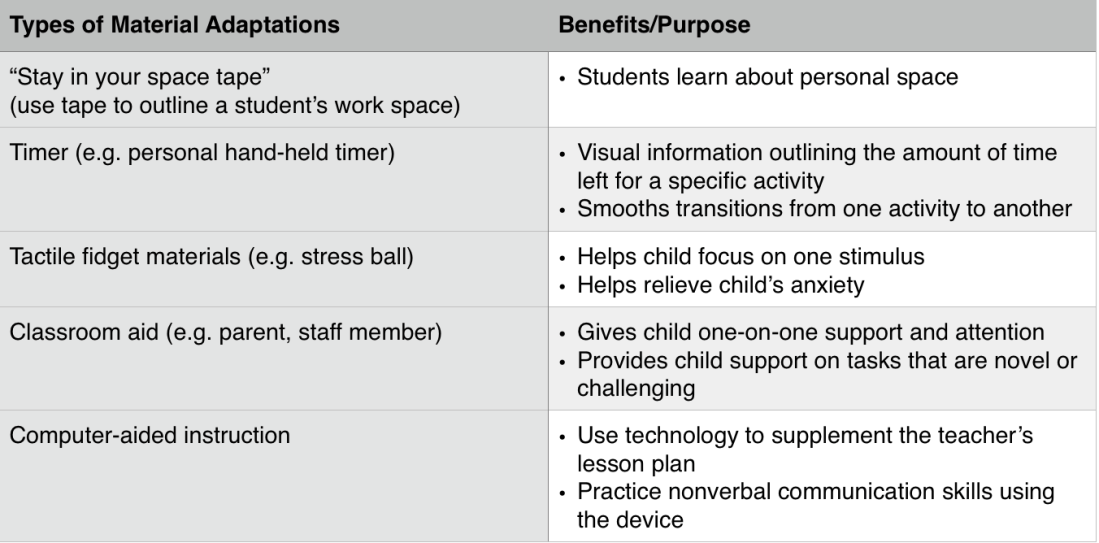
Researchers Brodzeller et al. (2018) concluded that there are certain strategies early childhood educators may implement, within inclusive settings, to help autistic children succeed in a classroom environment. These researchers worked one-on-one with Allen, a kindergartener who lies on the autism spectrum. Allen mainly struggles with cooperating during learner-centered activities and he has a hard time effectively communicating with his teachers and peers. To address his difficulties, Allen’s educators created a curriculum that was conducive to his needs. The results of this case study indicate that “material adaptations” can lessen autistic children’s anxiety and minimize sensory stimuli that typically over-stimulate them. One example of a material adaptation, which worked well for Allen, is the use of noise-dulling headphones; this accessory blocks out excess noise in the environment which allowed Allen to better focus on the task at hand. In addition, many autistic children, including Allen, are visual learners. Thus, using visual aids (such as videos that illustrate prosocial behavior) helped Allen acquire appropriate social skills because he modeled what he viewed.
What can you take away from this study? Don’t be afraid to try it out! If you recall, I mentioned that autism is a spectrum. This means that every individual with autism exhibits unique characteristics and behaviors. Thus, the autistic student you work with is not guaranteed to undergo the same experiences or challenges as Allen. The chart below provides additional examples of material adaptations. Take a look at these examples and find one that resonants with you or simply sounds interesting. Once you begin working with an autistic student, incorporate this material adaptation in your classroom and conclude whether or not it benefitted this particular student.
The Benefits Of Using Reinforcements With Autistic Preschoolers:
We are all familiar with the behavioral psychology concept of “reinforcement/s”; we know that rewards are used to strengthen a desired behavior. An example includes giving an autistic student a sticker, after watching him/her appropriately interact with his/her peer during playtime. The purpose of the sticker is to increase the likelihood that the autistic student will repeat this desirable and prosocial behavior in the future. The concept is pretty simple, right?
Good news! Two studies conducted in 2011 and 2012 concluded that using reinforcements with children who lie on the autistic spectrum can greatly improve their attention skills. The ability to sustain attention is undoubtedly critical for learning and therefore an important skill to develop. In fact, learning can only occur when the learner attends to the environment and absorbs the presented information. Researchers Watson and Pattern (2011) claim that there are various types of attention, including sustained attention (the ability to maintain attention for a long period of time) or joint attention (the ability to coordinate attention around a single object with a social partner). One effective way of improving autistic children’s attention skills is by providing reinforcements in the classroom. With increased attention abilities, students will unlikely disengage in the classroom material or dwell on irrelevant aspects of the lesson plan.
Following The Student’s Lead & Teaching Based Off Of The Student’s Interests:
Remember that joint attention is the ability to coordinate attention around a single object with a social partner. According to researchers Kaale, Smith, and Sponheim (2012), children with autism show deficits in joint attention. Consequently, their social development is negatively impacted. In addition to providing reinforcements, another way to improve autistic children’s joint attention skills is by implementing naturalistic interventions in the classroom (Pindiprolu, 2012). This type of intervention is characterized by a child initiating a desire to learn and an adult reinforcing that child’s behaviors. For this reason, naturalistic interventions foster learner spontaneity. The child may indicate a “desire to learn” by looking, reaching, gesturing, naming, or requesting an item. You, as the teacher, should join in the autistic child’s toy interests, follow the child’s lead, and verbalize exactly what the child is doing. Following these strategies/tips will increase children’s abilities to gaze, point, attend to an object, et cetera. Moreover, adopting this strategy will not only promote teacher-child play, but it has also been shown to positively impact mother-child play at home (Kaale, Smith, & Sponheim, 2012). As a result, engaging in naturalistic interventions inside the classroom will improve autistic children’s joint attention skills and, in turn, cultivate social interaction.
Focusing On Developing Autistic Children’s Communication Skills & Social Skills:
Back in 2016, researcher Grossi-Kliss conducted a survey with preschool teachers who reported that improving autistic children’s communication skills and social skills is vital. Building communicative skills will help children with ASD effectively interact with their instructor/s and classroom peers. Additionally, developing social skills (e.g. engaging in pretend play) will protect against a child’s social isolation. In the eyes of the teachers who participated in this survey, motor skills were the least important to strengthen in the preschool classroom. Unlike an occupational therapist, refining a fine or gross motor skill is not an educator’s main concern. This means that teachers are not responsible for having to ingrain each and every skill in their students. The conclusions of this study should also help you, as a future educator, create a curriculum that is centered around addressing the communication and social skills of your students. Grossi-Kliss’s findings nicely align with the results of the studies I described above because they address autistic children’s communication and social skills as well.
Main Takeaways & Classroom Applications:
With all of these research-based methods and research studies in mind, I will highlight the main takeaways!
Teachers should…
- Get to know the unique strengths and weaknesses of each autistic student because autism is a spectrum disorder; no two individuals are exactly alike.
- Adapt and alter their curriculum to align with students’ interests and needs.
- Create a curriculum that addresses students’ social skills and communication skills.
- Use material adaptations (e.g. noise-canceling headphones) to reduce distracting, excess environmental stimuli and to help students focus on the task at-hand.
- Use reinforcements as part of a behavior intervention plan; reinforcements increase the repetition of a desirable action and/or behavior.
- Use reinforcements to increase children’s attention abilities/skills.
- Allow the student to ‘take the lead’ and play an active role in their learning experience.
As you get ready to become an educator keep these findings in mind. I will leave you on this note: It is imperative to create a classroom environment that is receptive to the needs of children with ASD because it will provide a pathway for their future success. At the end of the day, what more can a preschool teacher ask for?
References
Brodzeller, Katharine L., Ottley, Jennifer R., Jung, J., Coogle, Christan G. (2018). Interventions and Adaptations for Children with Autism Spectrum Disorder in Inclusive Early Childhood Settings. Early Childhood Education Journal, 46(3), 277-286.
Grossi-Kliss, J. (2006). Teaching children with autistic spectrum disorder: A preschool teacher survey to determine best practice approach. Journal of the American Academy of Special Education Professionals, , 1-10. Retrieved from https:// search.proquest.com/docview/1913353987?accountid=14505
Kaale, A., Smith, L., & Sponheim, E. (2012). A Randomized Controlled Trial of Preschool- Based Joint Attention Intervention for Children with Autism. Journal of Child Psychology and Psychiatry and Allied Disciplines, 53(1), 97.
Patten, E., & Watson, L. R. (2011). Interventions targeting attention in young children with autism. American Journal of Speech-Language Pathology, 20(1), 60-69. doi:http:// dx.doi.org/10.1044/1058-0360(2010/09-0081)
Pindiprolu, S. S. (2012). A review of naturalistic interventions with young children with autism. Journal of the International Association of Special Education, 13(1), 69-78. Retrieved from https://search.proquest.com/docview/1312419718? accountid=14505


 UWP 104D